A loop of thought on one idea has a recognisable feel to it. You open the same notes, reread the same three points in favour and the same two against, and close the laptop with the sense that you have thought hard. The sitting felt like work because the idea is vivid and your attention was fully occupied, yet nothing exists at the end that did not exist at the start.
A useful test follows from that observation. After any sitting with the idea, check whether you can point to a written claim, question or decision that was not on the page before you began. Familiarity produces the sensation of progress without producing any of those. This is a working rule drawn from reasoning about how the loop behaves, and I am not citing a study for it.
A two-week log of one idea, with invented numbers
To make the test concrete, imagine a person who keeps returning to one idea, a weekly paid newsletter for local gardeners. During the first week they sit with it for thirty minutes a day, reread everything and count afterwards how many sittings produced something new. For the second week they change the method to twenty minutes a sitting, one question named beforehand, one written output at the end and two days of planned rest. Every number below belongs to this invented log, which illustrates the method and measures nothing about real people.
| Log | Day 1 | Day 2 | Day 3 | Day 4 | Day 5 | Day 6 | Day 7 |
|---|---|---|---|---|---|---|---|
| Week 1, rereading | 3 | 1 | 0 | 0 | 1 | 0 | 0 |
| Week 2, with a method | 2 | 1 | 0 | rest | 2 | 1 | rest |
The invented daily counts behind the chart, where rest marks a planned day with no sitting.
Week one held seven sittings of thirty minutes, and four of them produced nothing new. The five new items came from three sittings, and three of those five arrived on the first day, when the idea was still unfamiliar. Week two held five sittings of twenty minutes that produced six new items, and only the third produced nothing new.
| Week | Method | Sittings | Minutes each | With something new | Repeat only | New items | Minutes per new item |
|---|---|---|---|---|---|---|---|
| Week 1 | Rereading | 7 | 30 | 3 | 4 | 5 | 42 |
| Week 2 | Question and time limit | 5 | 20 | 4 | 1 | 6 | 17 |
Weekly totals from the same invented log, including the time spent per new item, which divides all minutes by the count of new items.
Minutes per new item fell from 42 to 17 after rounding, but the comparison carries little weight beyond illustration. One person, one idea and a count kept by the same person leave no way to separate the effect of the method from the effect of a fresh start on day eight.
Give each sitting one question, a time limit and a written output
The method in the second week has three parts, and each part removes a way for the loop to continue. A question named before you begin stops the sitting from becoming a general survey of everything you already know. A time limit of twenty minutes or so makes the end of the sitting arrive before the thinking has circled back to its start. A written output, one sentence long if need be, creates the thing that the test above looks for.
The gardener asked on day eight which of the three reasons in favour a stranger would pay for, and wrote down a decision to put that single question to five local gardeners by message. Count the repeat-only sittings as you go. A single one means little, since some days produce nothing. Three in a row is my own rule of thumb for saying that the idea needs a different kind of pressure rather than another reread.
Three ways out when the repeats keep coming
Once the repeats are visible the choice is among three exits: change the idea under pressure, set it aside until a fixed date or drop it. Each one is a legitimate decision, and the loop tends to persist when none of them has been chosen. The table below pairs common symptoms with my reading of what each usually means and a move that interrupts it, and those readings come from reasoning and experience rather than from measurement.
| Loop symptom | What it usually means | A move that breaks it |
|---|---|---|
| You rewrite the same pros and cons list every sitting | The list is complete and the missing information lives outside your head | Put one question to one person this week that the list cannot answer |
| Every argument ends with needing more certainty first | Certainty has been made a condition for the step that would supply it | Pick the smallest step whose result would change your mind and write that result down in advance |
| You reread all the notes from the beginning each time | The notes have become a ritual that no reader needs | Write a one-paragraph version and archive the rest for a week |
| The idea gets larger with each pass | The scope is absorbing the doubt that belongs to the idea | Cut it to a version that could be tried in a single weekend |
| Picturing the next step lowers your interest | The idea may have finished its work for you | Check the two signs for dropping it, described further down |
Common loop symptoms, the reading I would give each and one move that interrupts it.
Changing the idea under pressure means altering it before the next sitting begins, with a constraint that will not let you carry on as before. Three kinds of constraint tend to work well. You can halve the scope until the idea fits into a week, turn the premise over by writing the opposite claim and asking what would have to be true for it to hold, or require the idea to survive one conversation with someone who has no stake in it. In the gardener example the premise was that more reasons would eventually make the person ready, and the opposite premise, that readiness arrives only when someone else says yes or no, pointed straight at the message to five gardeners.
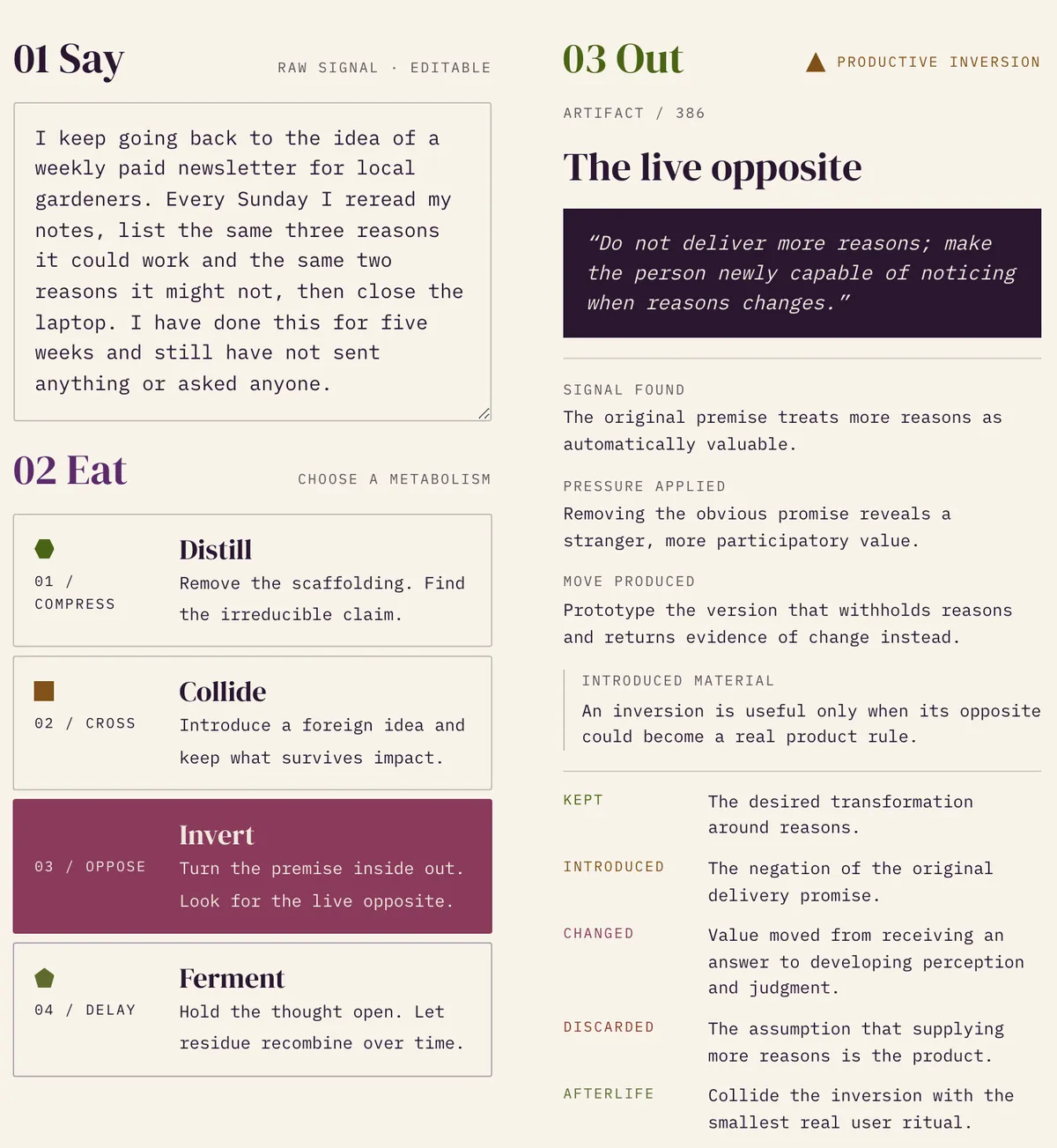
The pass shown above reached a move close to the by-hand inversion, though its wording was generic and the by-hand version is the more specific of the two. Treat a result like that as a prompt to examine, and check it against what you know about the idea.
Setting an idea aside until a fixed date works when the sittings have run dry but the idea has not been tested. The rest has to carry two things to count as a decision, which are a date and a question. Write the date in a calendar, write the single question you will answer on that day and leave the notes alone in between. A rest without a date and a question is the loop moved out of sight, because the idea keeps running in the background with nobody accountable for it. I know of no study that says how long such a rest should last, so treat one to two weeks as a working default and adjust it after seeing what the return sitting produces.
Dropping the idea is the exit people avoid because it feels like admitting a loss, though it is sometimes the sensible reading of weeks of repeats. Two signs favour it: the next step has been named at least three times and never taken, and picturing that step lowers your interest rather than raising it. Neither sign is proof, and both are my own rule of thumb. Before you close the idea, write a short note recording what you learned, what the idea would need in order to be worth reopening and the date you wrote it. The note takes about ten minutes. It turns a nagging obligation into a finished item that you can reopen on purpose if circumstances change.
What to do tomorrow and what remains unknown
Tomorrow, before you open the notes, write the one question the sitting will answer, set a timer for twenty minutes and leave a line at the bottom of the page headed Output. When the timer ends, write one claim, question or decision under that line, or write the word repeat if nothing new has appeared, and keep a running tally of each. If three repeats arrive together, choose an exit that same day and write the choice down with its date or its question.
Several things remain unknown, and the numbers in this post are among them. The twenty-minute limit, the three-repeat trigger and the rest of one to two weeks all come from reasoning about how loops behave, and I have no evidence that any particular number suits most people. This invented log cannot show that the method works for you. Your own tally after two weeks, kept with the same counts as the table above, is the only evidence that will bear on your own idea, and it may show that the loop concerns a decision you are avoiding.